

Quartz vs Granite Bathroom Countertops in Orlando FL: Your Complete 2026 Comparison Guide
Quick Answer
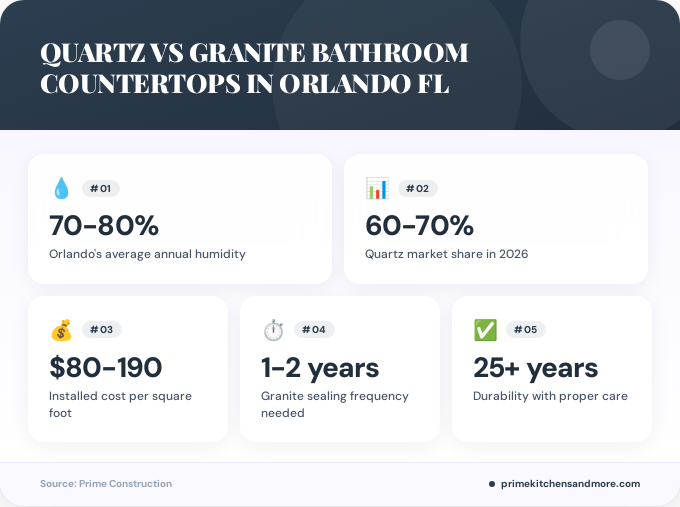
For Orlando, FL bathrooms, quartz countertops are generally recommended over granite due to their non-porous, stain-resistant surface that thrives in the area’s 70-80% humidity climate, requiring no sealing. Granite offers unique natural beauty and superior heat resistance but needs professional sealing every 1-2 years, especially in Florida’s moisture-rich environment. Both materials deliver 25+ years of durability with proper care, with installed costs ranging from $80 to $190 per square foot depending on quality, thickness, and project complexity.
Choosing between quartz and granite for your bathroom countertops represents one of the most significant decisions in your Orlando renovation project. With the local countertop market showing quartz capturing approximately 60-70% of bathroom installations in 2026, the question isn’t just about aesthetics anymore—it’s about which material performs best in Central Florida’s unique subtropical environment.
For Orlando homeowners planning bathroom renovation projects, understanding how these materials respond to humidity, heat, and daily wear determines not just your immediate satisfaction but your long-term investment value. Both materials offer compelling advantages, but one typically emerges as the superior choice for Florida’s demanding climate conditions.
What Makes Quartz and Granite Different for Orlando Bathrooms?
The fundamental difference between quartz and granite lies in their composition and how they’re created. Granite is 100% natural stone, quarried directly from the earth and cut into slabs, meaning each piece displays completely unique patterns, veining, and color variations that can never be replicated.
Quartz countertops, conversely, are engineered surfaces composed of approximately 90-95% crushed natural quartz bound together with polymer resins and pigments. This manufacturing process, significantly enhanced in 2026 with advanced resin formulations, creates a highly uniform, non-porous surface that delivers consistent performance across every installation.
According to material performance studies for Orlando-area homes, these compositional differences create dramatically different maintenance requirements and performance characteristics in bathroom environments, particularly where moisture exposure remains constant.
How Does Orlando’s Climate Impact Your Countertop Choice?
Orlando’s subtropical climate presents unique challenges for bathroom surfaces. The area experiences average annual humidity levels between 70-80%, with summer months regularly exceeding 90% humidity combined with temperatures routinely reaching the mid-90s Fahrenheit.
This moisture-saturated environment affects granite and quartz differently. Granite’s natural porosity means it can absorb moisture, potentially leading to bacterial growth, staining, or even mold development if not properly sealed and maintained. The performance of stone countertops in Florida’s climate shows that unsealed granite faces significant vulnerability in high-humidity bathroom environments.
Quartz’s engineered, non-porous surface naturally resists moisture penetration without any sealing requirements. For neighborhoods from Winter Park to Lake Nona, where summer humidity creates constant bathroom moisture, this characteristic proves invaluable. Many homeowners completing bathroom remodel projects in Orlando prioritize this moisture resistance as their primary decision factor.
Which Material Offers Better Durability and Longevity?
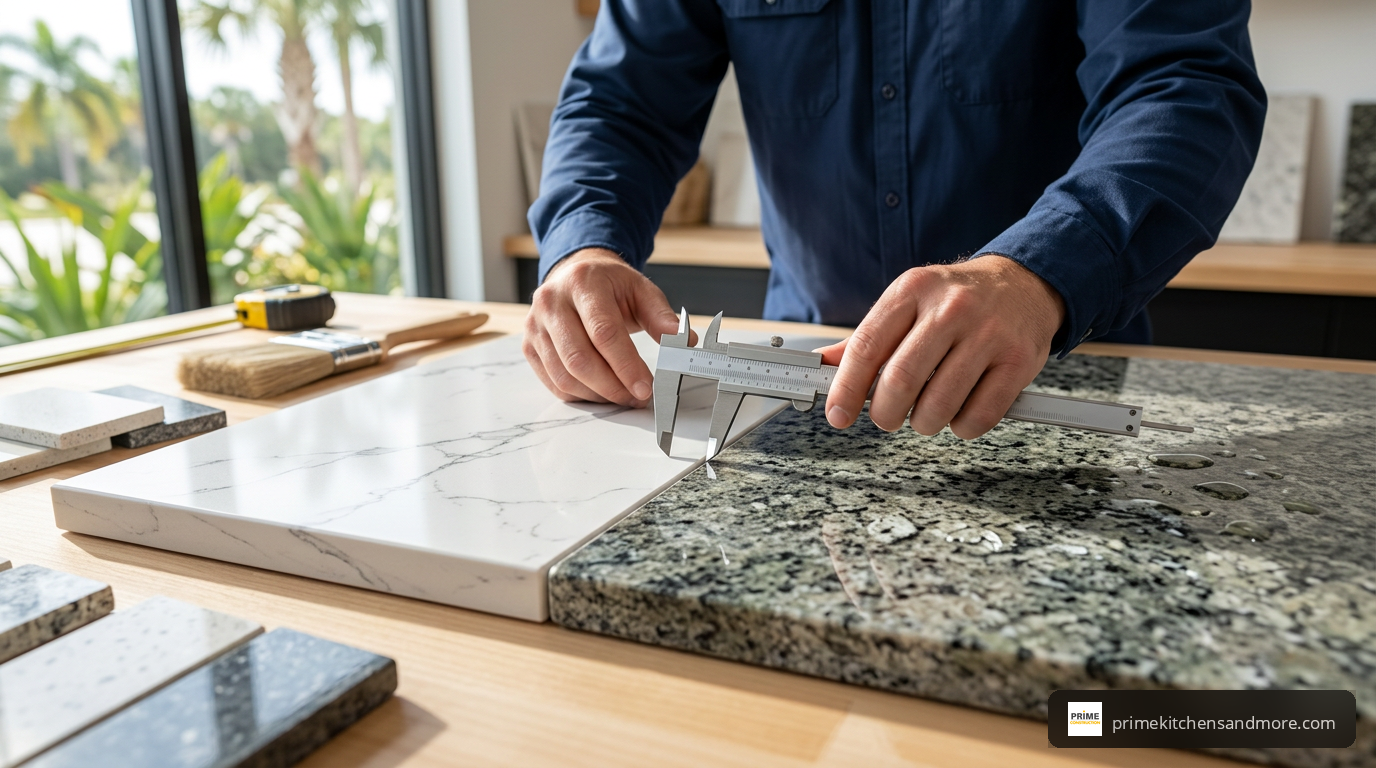
Both materials deliver exceptional durability, with documented lifespans exceeding 25 years when properly maintained. However, their durability characteristics differ in meaningful ways for bathroom applications.
| Durability Factor | Quartz | Granite |
|---|---|---|
| Mohs Hardness | 7 (highly scratch-resistant) | 6-7 (very scratch-resistant) |
| Porosity | Non-porous (zero absorption) | Porous (requires sealing) |
| Impact Resistance | Excellent (2026 resin improvements) | Very good (can chip at edges) |
| Bacterial Resistance | Superior (non-porous surface) | Good when sealed properly |
Quartz rates 7 on the Mohs hardness scale, with 2026 manufacturing advancements incorporating enhanced polymer resins that significantly improve impact resistance and reduce the risk of blemishes or surface damage. This makes it particularly suitable for busy family bathrooms where cosmetics containers, hair styling tools, and other items regularly contact countertop surfaces.
Granite offers comparable scratch resistance but its natural structure makes it more susceptible to chipping, particularly along exposed edges near bathroom vanities. The material’s inherent brittleness means dropped objects can potentially cause chips that quartz’s more flexible resin-bound structure typically resists.
What Are the Maintenance Requirements for Each Material?
Maintenance represents one of the most significant differentiators when comparing quartz vs granite bathroom countertops in Orlando FL. The time, effort, and ongoing costs associated with maintaining each material can substantially impact your long-term satisfaction and total ownership costs.
Quartz requires minimal maintenance: routine cleaning with mild soap and water suffices for daily care. No sealing, no special treatments, and no ongoing maintenance contracts. The non-porous surface resists staining from common bathroom products like makeup, toothpaste, hair dye, and cosmetics without requiring immediate cleanup.
Granite demands considerably more attention. Professional sealing every 1-2 years remains essential to maintain the stone’s stain and moisture resistance, particularly in Orlando’s humid climate. This sealing process typically costs between $150 to $400 per application depending on countertop size and service provider, adding ongoing expense throughout the countertop’s lifetime.
For homeowners exploring bathroom renovations in Orlando, this maintenance differential often proves decisive. The time saved on upkeep, combined with eliminated sealing costs, means quartz can actually prove more economical over a 25-year lifespan despite potentially higher initial installation costs.
How Do Costs Compare for Quartz vs Granite in Orlando?
Pricing for countertop materials varies dramatically based on quality grade, thickness, edge treatments, color rarity, and installation complexity. For bathroom projects in the Orlando area, understanding the full cost spectrum helps establish realistic budget expectations.
Quartz installed costs in 2026 range from $85 to $190+ per square foot for Orlando bathroom installations. This range encompasses entry-level manufactured quartz at the lower end through premium designer collections featuring unique colors and patterns at the upper range. For a typical 40-square-foot bathroom countertop, total project costs span from approximately $3,400 to $7,600 or more, depending on material selection, edge profiles, and installation requirements.
Granite installed costs range from $80 to $170+ per square foot, historically offering a slight cost advantage over quartz. However, this gap has narrowed significantly since 2020 as Florida homeowner cost data shows quartz manufacturing efficiency has improved while granite remains subject to international market fluctuations and shipping costs.
Pricing varies tremendously based on your specific project scope, material quality preferences, and design complexity. Premium granite featuring rare exotic colors or dramatic veining patterns commands prices at or above premium quartz options. Additionally, granite’s ongoing sealing requirements add $150 to $400 every 1-2 years, potentially totaling $2,000 to $5,000+ over a 25-year lifespan.
Both materials typically include 10-year manufacturer warranties against defects when professionally installed by certified contractors. For accurate project pricing tailored to your specific bathroom design, dimensions, and material preferences, consulting with experienced bathroom remodeling contractors provides the most reliable cost estimates.
What Aesthetic Options Does Each Material Offer?
Aesthetic preferences significantly influence the quartz vs granite decision, with each material offering distinct visual characteristics that appeal to different design sensibilities popular throughout Orlando neighborhoods from Baldwin Park to Dr. Phillips.
Granite delivers completely unique, one-of-a-kind natural patterns that can never be exactly replicated. Each slab displays distinct veining, mineral deposits, and color variations created by geological processes over millions of years. This natural uniqueness appeals to homeowners seeking authentic, traditional, or rustic bathroom aesthetics. Granite patterns range from subtle speckled appearances to dramatic swirling veins in virtually every color palette imaginable.
Quartz offers consistent, uniform appearances with predictable patterns, making it ideal for contemporary, modern, and minimalist bathroom designs. Manufacturers can create virtually any appearance, from solid colors to patterns mimicking natural marble, granite, or even concrete. The 2026 quartz market features increasingly sophisticated designs, including large-format slabs with continuous veining that rivals natural stone’s visual appeal.
Orlando design trends in 2026 show strong preference for quartz in clean, contemporary bathroom renovations, particularly in newly constructed homes and modern remodel projects. Many homeowners completing quartz countertop bathroom designs appreciate the ability to select exact colors and patterns that coordinate perfectly with tile, paint colors, and fixtures.
Granite maintains popularity for more traditional, Mediterranean, and transitional bathroom styles common in established Orlando neighborhoods. Its natural variation and organic patterns complement wood cabinetry, bronze fixtures, and earth-tone tile selections particularly well.
How Do Heat Resistance and Stain Resistance Compare?
Performance characteristics beyond basic durability influence how well each material serves in daily bathroom use, particularly regarding resistance to heat, stains, and chemical exposure from common bathroom products.
Heat resistance represents granite’s most significant performance advantage. Natural stone handles direct heat exposure without damage, meaning hot hair styling tools can contact the surface without causing discoloration or damage. Granite withstands temperatures exceeding 1,000°F without issue.
Quartz heat resistance has improved significantly with 2026 resin formulations, but hot items can still potentially cause discoloration or damage. Manufacturers recommend using trivets or mats under curling irons, flat irons, and other heated styling tools. However, this limitation proves minimal for most bathroom applications where extreme heat exposure remains limited compared to kitchen environments.
Stain resistance favors quartz dramatically. The non-porous engineered surface resists staining from makeup, hair dye, nail polish, toothpaste, and other common bathroom products without requiring immediate cleanup. According to countertop performance research for busy families, this characteristic makes quartz the preferred choice for households with children or multiple bathroom users.
Granite can stain when unsealed or when sealant wears down between maintenance applications. Hair dye, dark cosmetics, and acidic substances like certain cleaning products can potentially penetrate the stone’s surface, creating permanent discoloration. In Orlando’s high-humidity environment where moisture constantly challenges sealant effectiveness, this vulnerability increases compared to drier climates.
What Should You Know About Installation in Orlando?
Professional installation remains critical for both materials, with proper installation directly impacting longevity, performance, and warranty coverage. Orlando’s climate introduces specific installation considerations that professional contractors must address.
Both quartz and granite require professionally engineered support structures in bathroom vanity cabinets. Standard particleboard or MDF cabinetry may require reinforcement to support the substantial weight of stone countertops. Quality bathroom cabinet construction from Prime Kitchens and More includes proper structural support as standard.
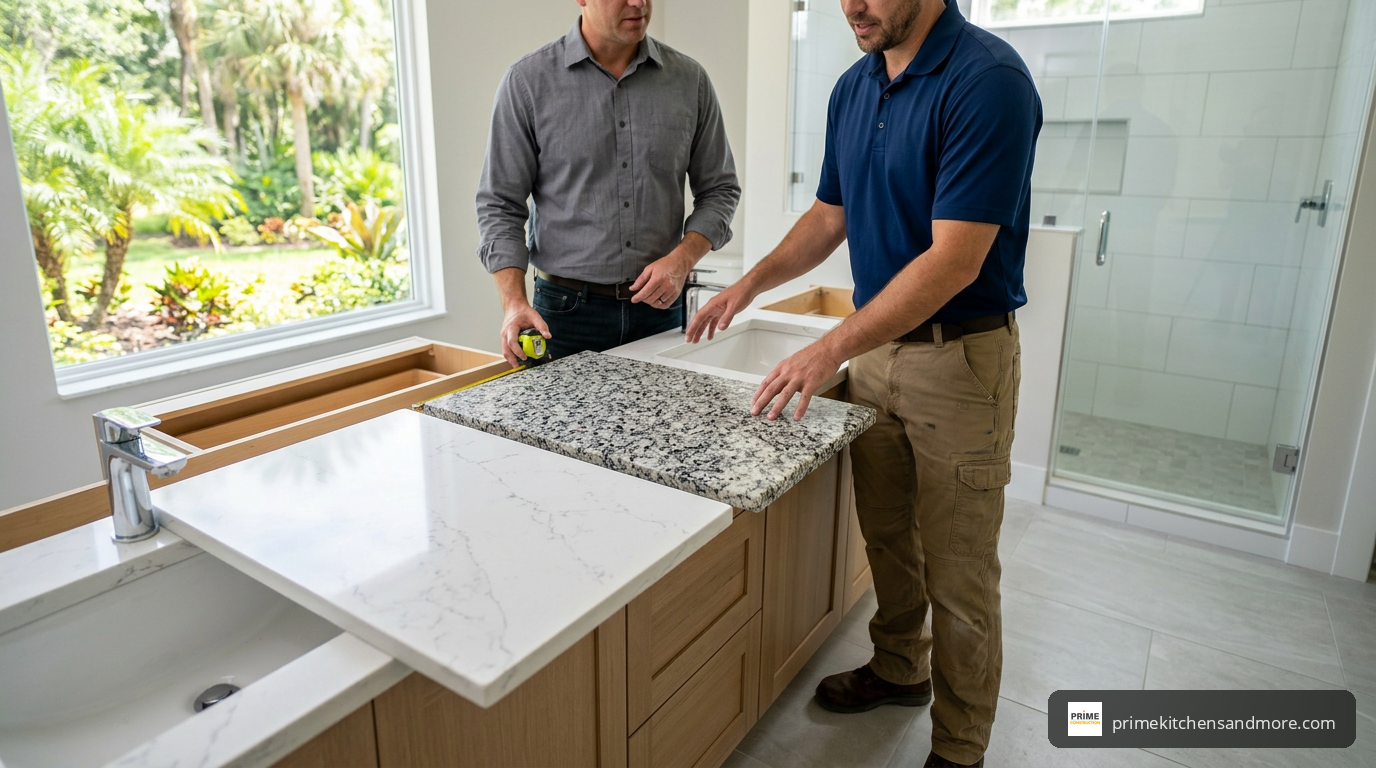
Template accuracy proves crucial, particularly for bathroom countertops incorporating undermount sinks, faucet placements, and precise measurements around toilets and tub surrounds. Professional fabricators use laser measuring technology to ensure perfect fits that prevent water infiltration and ensure clean, professional appearances.
Installation timeline typically spans 2-4 weeks from template to installation, including material selection, template creation, fabrication, and final installation. This timeline can extend during peak renovation seasons or when custom edge profiles and special fabrication requirements add complexity. The detailed bathroom remodeling process shows how countertop installation coordinates with other renovation phases.
Climate considerations during installation include ensuring proper adhesive curing in Orlando’s humidity. Professional installers account for seasonal moisture levels, adjusting installation techniques and curing times to ensure permanent, secure bonds between countertops and cabinetry.
Key Takeaways
- Quartz offers superior performance for Orlando’s humid climate with its non-porous, maintenance-free surface that resists moisture, bacteria, and staining without requiring sealing every 1-2 years like granite.
- Both materials deliver 25+ years of durability with proper care, rating 6-7 on the Mohs hardness scale, but quartz’s engineered composition provides better impact resistance enhanced by 2026 resin improvements.
- Installation costs range from $80-$190+ per square foot depending on material quality, project complexity, and design specifications, with pricing highly variable based on individual project requirements rather than fixed averages.
- Granite requires professional sealing every 1-2 years costing $150-$400 per application, adding $2,000-$5,000+ in maintenance expenses over 25 years compared to quartz’s soap-and-water cleaning.
- Aesthetic preferences drive material selection, with granite offering unique natural patterns ideal for traditional designs while quartz delivers uniform, contemporary appearances with predictable color matching.
- Heat resistance favors granite for direct contact with hot styling tools, but quartz’s stain resistance proves more valuable for typical bathroom use with makeup, hair products, and cosmetics.
- Professional installation remains essential for both materials, with proper fabrication, templating, and climate-appropriate installation techniques ensuring optimal performance and warranty coverage in Orlando’s subtropical environment.
People Also Ask
Is quartz or granite better for bathroom vanity tops?
Quartz is generally better for bathroom vanity tops due to its non-porous surface that resists moisture, bacteria, and staining without requiring sealing. Granite offers beautiful natural patterns but needs professional sealing every 1-2 years, making quartz the more practical choice for high-moisture bathroom environments.
How long do quartz and granite bathroom countertops last?
Both quartz and granite bathroom countertops last 25+ years with proper maintenance. Quartz requires only soap and water cleaning, while granite needs professional sealing every 1-2 years to maintain longevity. Both materials typically include 10-year manufacturer warranties when professionally installed.
Does granite stain in bathrooms?
Unsealed or improperly maintained granite can stain from hair dye, makeup, toothpaste, and other bathroom products because it is naturally porous. Regular professional sealing every 1-2 years protects against staining, but Orlando’s high humidity can accelerate sealant breakdown, requiring more frequent maintenance than in drier climates.
What countertop is best for Florida humidity?
Quartz performs best in Florida’s 70-80% average humidity because its non-porous engineered surface naturally resists moisture penetration without sealing. Granite can also work well but requires consistent professional sealing to prevent moisture absorption and potential mold growth in high-humidity bathroom environments.
Can you put hot curling irons on quartz countertops?
While 2026 quartz formulations show improved heat resistance, manufacturers recommend using trivets or heat-resistant mats under hot styling tools like curling irons and flat irons to prevent potential discoloration or damage. Granite handles direct heat better but quartz’s other performance advantages typically outweigh this limitation for bathroom use.
Is quartz more expensive than granite in Orlando?
Quartz typically costs slightly more initially, ranging from $85-$190+ per square foot installed versus granite’s $80-$170+ range in Orlando. However, granite’s ongoing sealing costs of $150-$400 every 1-2 years can total $2,000-$5,000+ over 25 years, potentially making quartz more economical long-term despite higher upfront investment.
Frequently Asked Questions
Do I need to seal quartz bathroom countertops in Orlando?+
No, quartz countertops never require sealing because they are engineered with non-porous surfaces that naturally resist moisture, bacteria, and staining. This makes them particularly ideal for Orlando’s humid climate where maintaining granite sealant proves challenging and requires professional reapplication every 1-2 years.
Which is easier to clean, quartz or granite bathroom countertops?+
Quartz is significantly easier to clean, requiring only mild soap and water for routine maintenance with no special cleaners or treatments needed. Granite needs pH-neutral cleaners designed for natural stone to avoid damaging the sealant, plus professional sealing every 1-2 years adds ongoing maintenance requirements that quartz eliminates entirely.
Will granite crack in my Orlando bathroom?+
Properly installed granite rarely cracks under normal bathroom use, though it can chip along edges if struck by heavy objects. Both granite and quartz deliver excellent durability when professionally installed with proper support structures, but quartz’s resin-bound composition offers slightly better impact resistance than granite’s natural crystalline structure.
Can I install quartz or granite bathroom countertops myself?+
DIY installation is strongly discouraged for both materials due to their extreme weight, specialized cutting requirements, and need for precise templating and fabrication. Professional installation ensures proper support structures, accurate measurements, appropriate adhesives for Orlando’s climate, and typically provides warranty coverage that DIY installation voids.
How do I choose between quartz and granite for my bathroom remodel?+
Choose quartz if you prioritize low maintenance, consistent patterns, and superior moisture resistance for Orlando’s humid climate. Select granite if you prefer unique natural patterns, need direct heat resistance for styling tools, and don’t mind professional sealing every 1-2 years to maintain performance and appearance.
Are there environmentally friendly options for bathroom countertops?+
Both materials offer environmental considerations: granite is 100% natural stone requiring quarrying, while quartz uses recycled materials in some formulations but involves resin production. Many 2026 quartz manufacturers incorporate up to 40% recycled content and pursue sustainable manufacturing certifications, making both viable options depending on your specific environmental priorities.
What thickness should I choose for bathroom countertops?+
Standard bathroom countertop thickness is 3cm (approximately 1.25 inches) for both quartz and granite, providing optimal durability and appearance. Some homeowners choose 2cm (approximately 0.75 inches) with laminated edges for budget considerations, though 3cm offers superior strength and typically includes beveled or decorative edge profiles without additional lamination.