


Quick Answer
The costliest kitchen remodeling mistakes in Orlando FL involve vague project scopes, underbudgeting for hidden damage, skipping permits, relocating plumbing or electrical without proper planning, and selecting materials that can’t handle Central Florida’s heat and humidity. Avoiding these errors typically requires detailed drawings, a 10 to 20 percent contingency reserve, licensed permitting, and climate-appropriate material choices from the start.
Here’s a sobering number: roughly one in three kitchen remodels in the United States runs over budget, and the overwhelming majority of those overruns trace back to decisions made before a single cabinet is removed. In Orlando, where humidity, older housing stock, and fast-growing neighborhoods collide, the margin for error shrinks even further. Avoiding kitchen remodeling mistakes in Orlando FL isn’t about luck. It’s about knowing where other homeowners got burned and planning around those exact failure points.
This guide walks through the most expensive, most common, and most preventable mistakes local homeowners make, backed by real Orlando cost data and the kind of hard-won field knowledge that only comes from decades of gut renovations across Central Florida.
What Does Kitchen Remodeling Cost in Orlando in 2026?
Before discussing mistakes, it helps to understand the baseline. Published Orlando estimates vary widely because they draw from different project scopes, but the general pattern holds: cosmetic refreshes sit far below mid-range remodels, and full custom gut jobs sit far above them. According to Thumbtack’s Orlando kitchen remodel cost data, a reported average across hundreds of local projects lands in the mid-$30,000s, though individual projects swing dramatically based on cabinet grade, countertop material, and labor availability.
| Project Type | Typical Orlando Range |
|---|---|
| Cosmetic refresh (paint, hardware, fixtures) | $5,000 to $15,000 |
| Budget remodel (refacing, laminate counters) | Starting around $11,500 |
| Mid-range remodel (cabinets, counters, appliances, flooring) | $25,000 to $60,000+ |
| High-end custom or full-gut remodel | $75,000 to $150,000+ |
These are planning ranges, not quotes. Pricing varies based on your specific project, cabinet construction, countertop material, appliance package, and whether structural or utility work is involved. If you want a realistic sense of where your project will land, review our detailed breakdown of kitchen remodeling costs in Orlando or request a custom itemized quote before committing to a direction.
Why Does Skipping a Detailed Scope Cause So Many Problems?
The single most common and most expensive mistake is starting a project with a vague goal like “update the kitchen” instead of a documented plan. Vague scopes invite change orders, and change orders are where budgets quietly spiral. Before signing anything, your proposal should specify exact cabinet dimensions, appliance rough-in requirements, countertop material and edge profile, lighting and outlet locations, flooring transitions, and who is responsible for permits and disposal.
Just as important: your contractor’s proposal needs to clearly separate allowances, fixed prices, and owner-selected items. An allowance is a placeholder number, not a guaranteed final cost, and homeowners who treat allowances as locked-in prices are frequently blindsided when they select a nicer tile or a heavier countertop slab.

How Much Contingency Budget Do Orlando Homeowners Really Need?
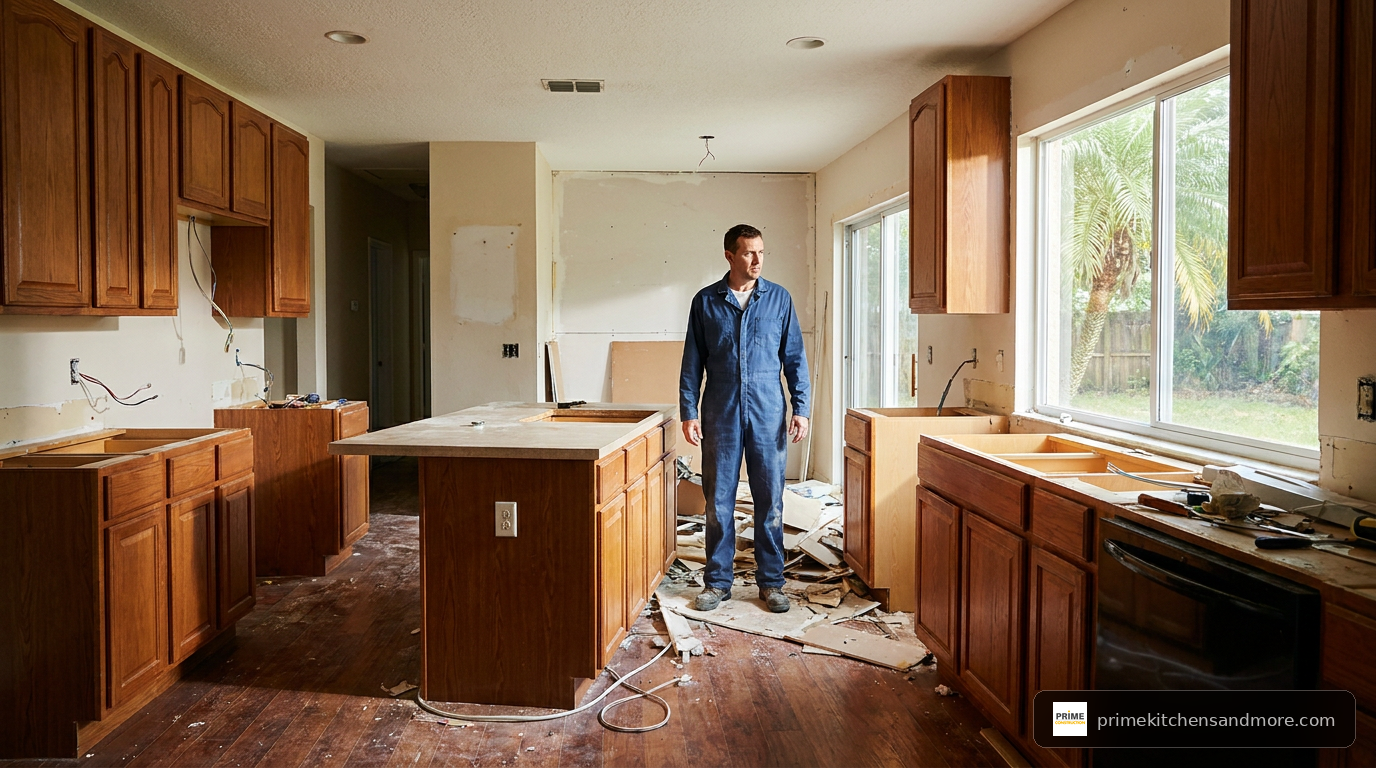
Orlando’s housing stock includes a large share of homes built from the 1970s through the 1990s, many with outdated wiring, undersized electrical panels, or plumbing that doesn’t meet current code. Opening a wall or pulling old cabinetry often reveals water damage, termite activity, or galvanized pipe that nobody budgeted for.
Set aside at least 10 to 20 percent of your total construction budget as a contingency reserve for hidden damage, outdated wiring, plumbing failures, and subfloor issues discovered during demolition. Homeowners who skip this step often pause mid-project waiting on financing, which extends the timeline and increases labor costs. For a deeper look at how these cost components break down, our guide to kitchen remodel planning in Orlando FL walks through typical allowances for cabinets, labor, countertops, and mechanical work.
Largest single line item in most budgets
Skilled trades run $80–$120/hour
Quartz runs $70–$120/sq ft installed
Rises sharply if lines are relocated
What Happens When Orlando Homeowners Skip Permits?
Unpermitted work is one of the costliest long-term mistakes a homeowner can make, even though it feels like a shortcut at the time. Permits exist to confirm that electrical, plumbing, and structural changes meet Florida Building Code, and unpermitted work can create major problems during a home sale, an insurance claim, or a future renovation.
Local permitting requirements differ by jurisdiction, and Orlando-area homeowners should confirm specifics with their county before work begins. Both Hillsborough County’s homeowner permit guidance and Martin County’s “do I need a permit” resource outline the kinds of kitchen work that typically require a permit, including electrical relocation, new circuits, plumbing moves, and load-bearing wall changes. Miami-Dade’s residential permit portal offers another useful model for what documentation is typically expected statewide. A licensed Orlando remodeler should handle permit applications and inspections as part of the project, not as an optional add-on.
Why Is Relocating Plumbing or Electrical a High-Risk Decision?
Moving a sink, range, or refrigerator water line to achieve a better layout can transform a kitchen, but it’s also one of the most frequently underestimated line items. Relocating plumbing or gas lines typically runs $2,000 to $8,000, and that range climbs further if the slab needs to be cut or if the home’s existing electrical panel lacks capacity for new circuits.
Homeowners sometimes approve a layout change without first confirming whether the home’s electrical panel can support additional 20-amp circuits for modern appliances, or whether moving a gas line requires a secondary permit and inspection. A reputable Orlando contractor will flag these costs during the design phase, not after demolition has already started. For homes with mobility needs, utility relocation decisions carry extra weight, and our page on kitchen remodeling for seniors covers how to plan layout changes that support long-term accessibility.
Which Materials Fail in Florida’s Heat and Humidity?
Orlando’s climate is unforgiving on the wrong materials. High ambient humidity, frequent air conditioning cycling, and intense UV exposure near west-facing windows all accelerate wear on certain finishes. Particleboard cabinet boxes, untreated wood near sinks, and poorly sealed natural stone are common failure points within just a few years of installation.
The Florida Building Commission’s own materials guidance documentation underscores why humidity-resistant construction matters across the state, not just in coastal zones. Laminate countertops run roughly $20 per square foot installed and are budget-friendly, but they’re more vulnerable to heat damage near ranges. Granite typically runs $50 to $100 per square foot installed, while quartz, which resists moisture and doesn’t require sealing, runs $70 to $120 per square foot installed and tends to hold up best in Central Florida’s humidity. If you’re weighing material tradeoffs, our guide on kitchen cabinets in Orlando breaks down moisture-resistant construction options in more detail.
| Material | Humidity Performance |
|---|---|
| Laminate countertops | Lower cost, more vulnerable to heat/moisture near ranges |
| Granite | Durable but requires periodic resealing |
| Quartz | Non-porous, excellent humidity resistance, minimal maintenance |
Is DIY Kitchen Remodeling Worth the Risk in Orlando?
Many Orlando homeowners start a remodel intending to handle demolition or finish work themselves to save money, and this is where some of the biggest dangers emerge. Electrical and plumbing work performed without proper licensing not only risks code violations, it risks personal injury and water damage that can spread into subflooring and adjacent rooms within days in Florida’s humidity.
Beyond safety, DIY work frequently creates scheduling conflicts for licensed trades waiting on an amateur-finished step before they can proceed, which stalls the entire project. Resources like USA Cabinet Store’s overview of what to expect during an Orlando kitchen remodel reinforce that sequencing and trade coordination are often the hardest parts of a project to manage without professional oversight.
How Do You Choose the Right Contractor and Avoid Bad Bids?
Because published Orlando estimates vary so widely, from roughly $11,500 budget projects to $150,000+ custom builds, a single “average” number is almost meaningless for planning your own project. Homeowners should obtain at least three itemized bids that break out cabinets, countertops, labor, plumbing, electrical, and permit fees separately, rather than accepting one lump-sum number.
Watch for bids that seem dramatically lower than competitors without explanation, since this often signals missing scope items, unlicensed subcontractors, or allowances set unrealistically low to win the job. A trustworthy Orlando remodeler will walk you through the full kitchen remodeling process in Orlando and explain exactly what’s included, what’s an allowance, and what could change the price. If your project spans both spaces, our kitchen and bath remodeling services in Orlando page outlines how combined projects are typically scoped and sequenced.
For homeowners comparing multiple quotes or trying to understand where their numbers diverge, tools like PermitDeck’s Orlando kitchen remodel calculator can offer a useful sanity check, though nothing replaces a detailed, in-person itemized proposal from a licensed local contractor. You can also explore our broader overview of how to remodel your kitchen for a step-by-step planning framework, or learn how smart layout choices can enhance kitchen functionality through remodeling.
- Document everything before demo day: vague scopes are the number one cause of budget overruns in Orlando kitchen remodels.
- Reserve 10 to 20 percent of your construction budget for hidden damage common in Orlando’s older housing stock.
- Never skip permits for electrical, plumbing, or structural changes, since unpermitted work creates problems at resale and during insurance claims.
- Budget realistically for utility relocation, which typically runs $2,000 to $8,000 and can increase if panel upgrades are needed.
- Choose humidity-resistant materials like quartz over particleboard or unsealed natural stone, especially near sinks and ranges.
- Get at least three itemized bids rather than relying on a single average price, since Orlando estimates range enormously by scope.
- Avoid risky DIY electrical or plumbing work, which can stall licensed trades and create costly rework.
People Also Ask
What is the biggest danger of remodeling a kitchen yourself?
The biggest danger is attempting electrical or plumbing work without a license, which risks code violations, injury, and water damage that spreads quickly in Florida’s humid climate. DIY mistakes also frequently delay licensed trades who are waiting on earlier steps to be completed correctly.
Not every beautiful kitchen is a well-designed one, so what should homeowners prioritize?
Homeowners should prioritize workflow, storage, and ventilation over purely aesthetic choices, since a visually striking kitchen with poor layout or humidity-vulnerable materials will underperform within a few years. Functional design decisions made early, documented in detailed drawings, prevent costly layout changes mid-project.
How much should I budget for unexpected costs in an Orlando kitchen remodel?
Set aside 10 to 20 percent of your total construction budget as a contingency reserve. This covers hidden damage like outdated wiring, plumbing failures, or subfloor issues commonly found in Orlando’s older homes during demolition.
Do I need a permit for a kitchen remodel in Orlando?
Most kitchen remodels involving electrical, plumbing, or structural changes require a permit in Central Florida counties. A licensed contractor should handle the permit application and inspections as part of the project scope.
Frequently Asked Questions
What is the most common kitchen remodeling mistake in Orlando?+
The most common mistake is starting without a detailed scope and drawings. Homeowners who approve vague plans instead of itemized proposals with fixed prices, allowances, and owner selections tend to face the most change orders and budget overruns.
How much does a mid-range kitchen remodel cost in Orlando in 2026?+
Published estimates place mid-range Orlando kitchen remodels roughly between $25,000 and $60,000, though some estimators report ranges as wide as $15,750 to $68,250. Final pricing depends heavily on cabinet grade, countertop material, and whether plumbing or electrical relocation is involved.
Why does unpermitted kitchen work cause problems later?+
Unpermitted electrical, plumbing, or structural work can surface during a home sale inspection, insurance claim, or future renovation, often requiring costly retroactive corrections. Florida counties require permits specifically to verify that work meets current building code and safety standards.
What countertop material holds up best in Orlando’s humidity?+
Quartz generally performs best in Central Florida’s heat and humidity because it’s non-porous and doesn’t require sealing. It typically costs more than laminate or granite but reduces long-term maintenance and moisture-related damage.
How many bids should I get before choosing an Orlando kitchen contractor?+
Homeowners should gather at least three itemized bids that separately break out cabinets, countertops, labor, plumbing, electrical, and permit costs. Relying on a single average price can lead to surprises since Orlando project costs vary enormously by scope and material quality.
Is it a mistake to relocate the sink or range during a kitchen remodel?+
It’s not a mistake in itself, but relocating plumbing or gas lines without sufficient planning often causes budget surprises, typically adding $2,000 to $8,000 to the project. Confirm electrical panel capacity and permitting requirements before finalizing a new layout.
Should I remodel my kitchen myself to save money in Orlando?+
DIY work on electrical, plumbing, or structural elements carries significant safety and code risks, and mistakes often cost more to correct than hiring a licensed professional from the start. Cosmetic tasks like painting or hardware swaps are lower risk, but core remodeling work should go through a licensed Orlando contractor.
Avoiding kitchen remodeling mistakes in Orlando FL comes down to planning with the same rigor a contractor would use internally: detailed scope documents, realistic contingency reserves, proper permitting, and materials chosen for Florida’s climate, not just for looks. If you’re ready to start your project the right way, visit Prime Construction’s kitchen remodeling team or reach out through our contact page for a detailed, itemized quote built around your home’s specific needs. Learn more about our approach on our about page before scheduling your consultation.