
Understanding Quartz Stone: Natural Beauty Meets Modern Engineering
Quartz stone is a term that describes both a naturally occurring mineral and a popular engineered material used in countertops and surfaces. Understanding the difference is crucial for homeowners planning kitchen or bathroom remodels.
Quick Answer: What is Quartz Stone?
- Natural Quartz: A hard mineral composed of silicon dioxide (SiO2), ranking 7 on the Mohs hardness scale. It’s the second most abundant mineral in Earth’s lithosphere, making up about 12% by mass.
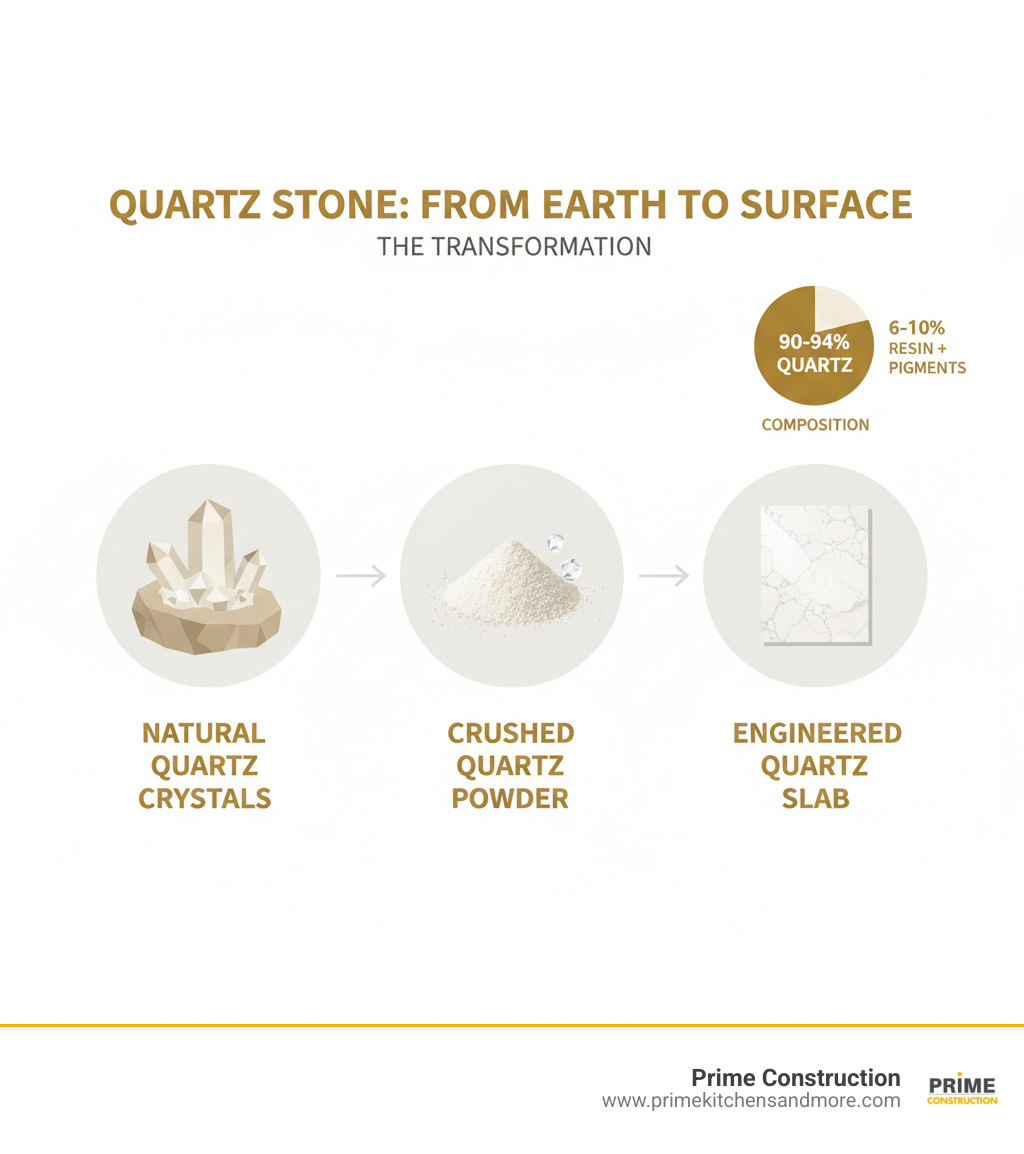
- Engineered Quartz: A man-made surface material composed of 90-94% crushed natural quartz crystals combined with 6-10% polymer resins and pigments.
- Key Difference: Natural quartz is a mineral found in rocks like granite. Engineered quartz is a manufactured product designed specifically for countertops and surfaces.
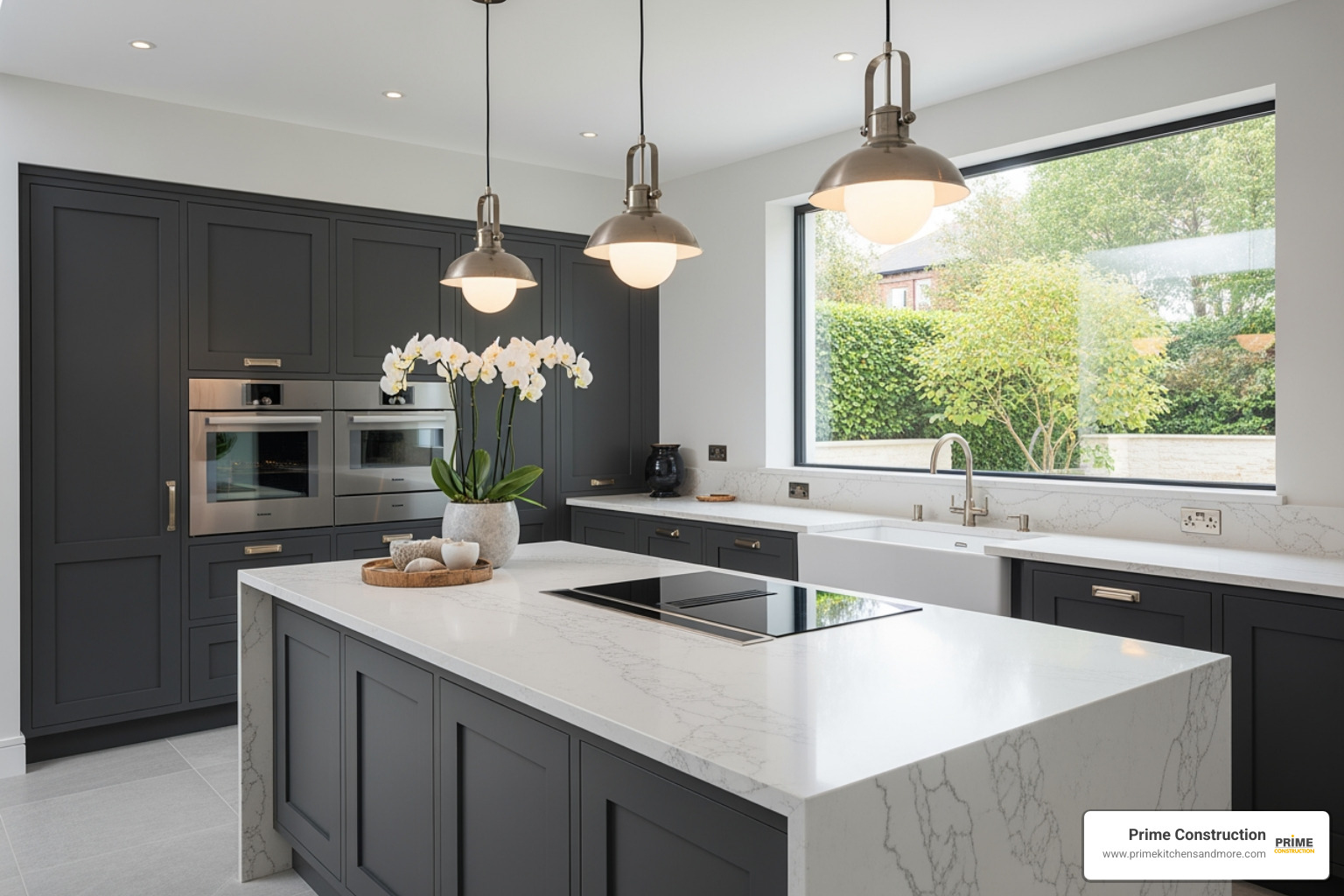
If you’ve been researching countertop options for your Orlando home, you’ve likely encountered quartz as a top recommendation. That’s because engineered quartz countertops offer the perfect marriage of function and style – combining the durability of natural stone with the consistency and low maintenance of a manufactured product.
Natural quartz has been valued throughout history. Ancient Greek philosophers believed it was a form of supercooled ice. Today, this remarkable mineral appears everywhere from your smartphone’s electronics to the stunning veined countertops in designer kitchens.
The confusion between natural quartz mineral and engineered quartz stone is common. Natural quartz is a component of many rocks, including granite and sandstone. When we talk about “quartz countertops” for your kitchen, we’re referring to engineered quartz – a composite material that takes crushed natural quartz and binds it with resin to create slabs with superior performance characteristics.
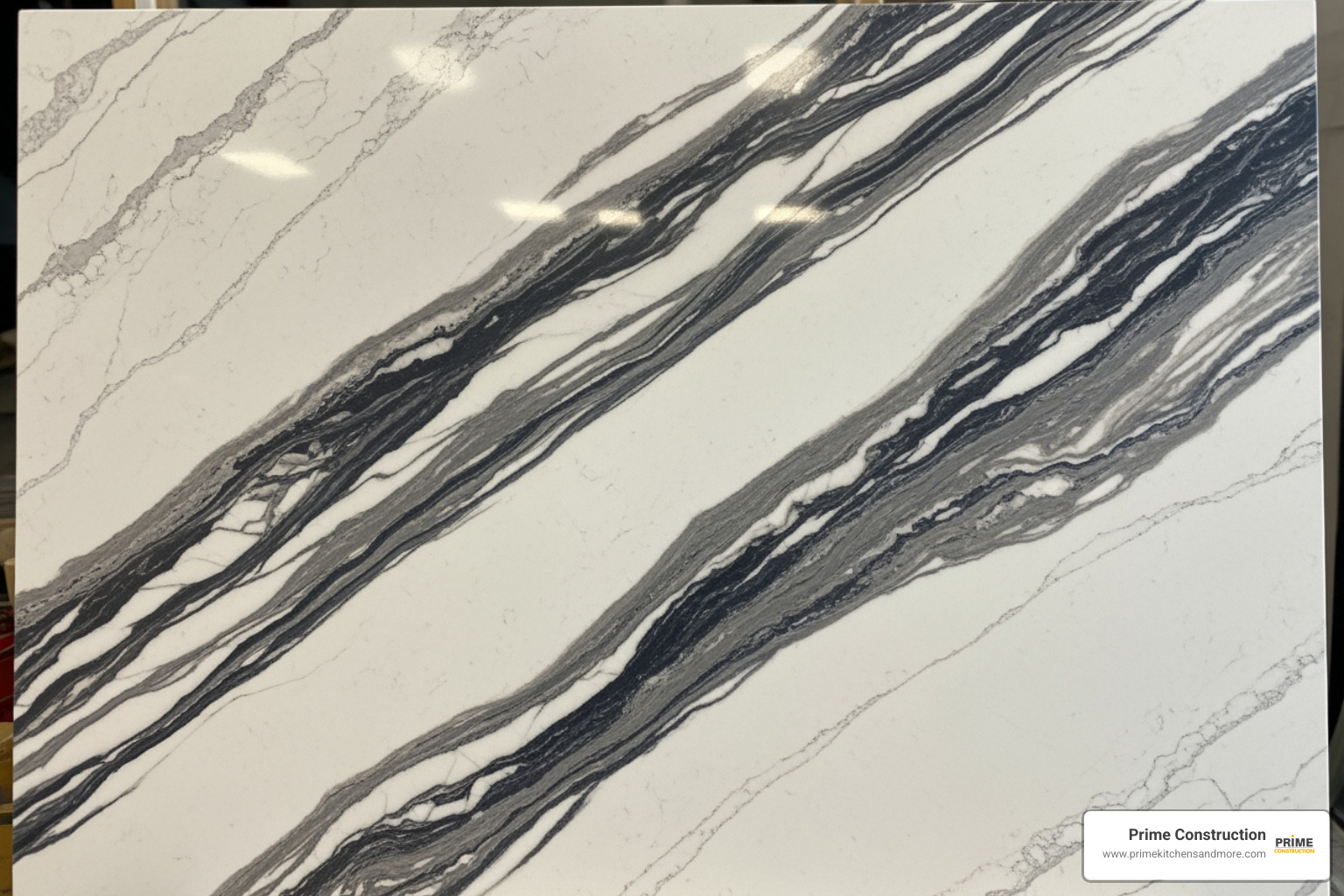
Engineered quartz surfaces are non-porous, stain-resistant, and require no sealing – unlike natural stone alternatives. They’ve become increasingly popular over the last 15 years, with major retailers now offering hundreds of color and pattern options that can replicate everything from classic marble to modern concrete aesthetics.
Whether you’re drawn to quartz for its durability, its design flexibility, or its low-maintenance appeal, understanding what this material truly is will help us make the best choice for your remodeling project.
The Science of Natural Quartz
Before we explore engineered surfaces, let’s talk about the star of the show: natural quartz stone. This mineral is more than just beautiful—it’s a geological wonder.

At its heart, quartz stone is made of silicon and oxygen atoms in a precise pattern with the chemical formula SiO2 (silicon dioxide). These atoms link together in a continuous framework, giving quartz its incredible strength and stability.
Quartz is the second most abundant mineral in Earth’s crust, making up about 12% of the lithosphere by mass. It exists in two main forms: Alpha-quartz, the common form we encounter, and Beta-quartz, which appears at temperatures over 573°C (1,063°F).
When it comes to toughness, quartz stone sets a high standard. It ranks 7 on the Mohs hardness scale, making it harder than steel and glass. Its physical characteristics include a glassy (vitreous) luster and a distinctive shell-like (conchoidal) fracture pattern, meaning it breaks along smooth, curved surfaces. If you’re interested in the deeper science, check out this comprehensive Mineralogy and mineral chemistry of quartz: A review.
What is Natural Quartz Stone?
The ancient Greeks called clear quartz stone ‘krystallos’, meaning “ice,” believing it was a form of permanently frozen water—a belief recorded by the Roman naturalist Pliny the Elder. Throughout history, quartz has been carved into sculptures, crafted into jewelry, and shaped into tools. Nature can create massive quartz crystals; the largest documented one, found in Brazil, weighed nearly 88,000 pounds!
A Spectrum of Natural Varieties
Natural quartz stone is not a single mineral but a whole family, classified by color and crystal size. The beautiful hues come from trace impurities or natural radiation effects during formation.
Macrocrystalline varieties have crystals visible to the naked eye. These include purple Amethyst, yellow-to-brown Citrine, pink Rose Quartz, and gray-to-black Smoky Quartz.
Cryptocrystalline varieties have microscopic crystals, giving them a smooth, often opaque appearance. This group, broadly known as chalcedony, includes artistically banded Agate, parallel-striped Onyx, colorful Jasper, and reddish-brown Carnelian.
Engineered Quartz Stone: The Modern Masterpiece
While natural stone is beautiful, its unpredictability and high maintenance can be a drawback. Engineered quartz solves these issues, changing crushed natural quartz into a practical, modern surface for your home.
Engineered quartz is a composite material that brings together natural beauty and modern performance. The manufacturing process typically follows the Breton method, using vibrocompression under vacuum. This technique creates dense, uniform slabs with virtually no porosity, making them incredibly durable.
With 15 years of experience installing these surfaces in Orlando homes, we know their consistency and reliability are perfect for custom projects where precision matters. If you’re planning a kitchen renovation, you can find more info about custom kitchen countertops on our website.
The Composition of Engineered Quartz Stone
What makes engineered quartz stone special is its recipe. Unlike natural stone, it’s formulated for specific performance. The mixture contains 90-94% ground natural quartz crystals (which are 99.9% pure silica), with the remaining 6-10% consisting of polymer resins and pigments.
This controlled composition provides remarkable advantages. First, there’s consistency. Every slab has a uniform structure with predictable color and pattern. This is ideal for large projects requiring multiple matching slabs, avoiding the variations found in natural stone.
Second, the resin binders create a completely non-porous surface. Liquids can’t penetrate it, meaning your countertops won’t harbor bacteria or mold. Spills like wine, coffee, or tomato sauce wipe away without a trace—a game-changing hygienic property for busy Orlando families.
From Slab to Surface: Finishes and Applications
Once manufactured, slabs are transformed into the surfaces that define your space. Engineered quartz stone comes in several finishes. Polished finishes offer a high-gloss, reflective surface that improves color and pattern. Honed finishes provide a smooth, matte appearance for a softer, contemporary look. A leathered finish has a slightly textured feel that adds character while hiding fingerprints.
Engineered quartz is incredibly versatile. Kitchen countertops are the most popular application due to the material’s durability, stain resistance, and low maintenance. Bathroom vanities are another perfect fit, as the non-porous surface resists moisture and stays pristine.
Beyond countertops, it’s great for flooring, wall cladding, tabletops, and fireplace surrounds. The possibilities are nearly limitless. If you’re dreaming of something truly unique, we can help. Visit our page for more info about custom made countertops to see what’s possible.
Choosing Quartz for Your Home
When you’re planning a kitchen or bathroom renovation in Apopka, Windermere, or anywhere across our service area, you want surfaces that work as hard as they look beautiful. That’s exactly what quartz stone countertops deliver – and it’s why so many of our clients choose them for their homes.
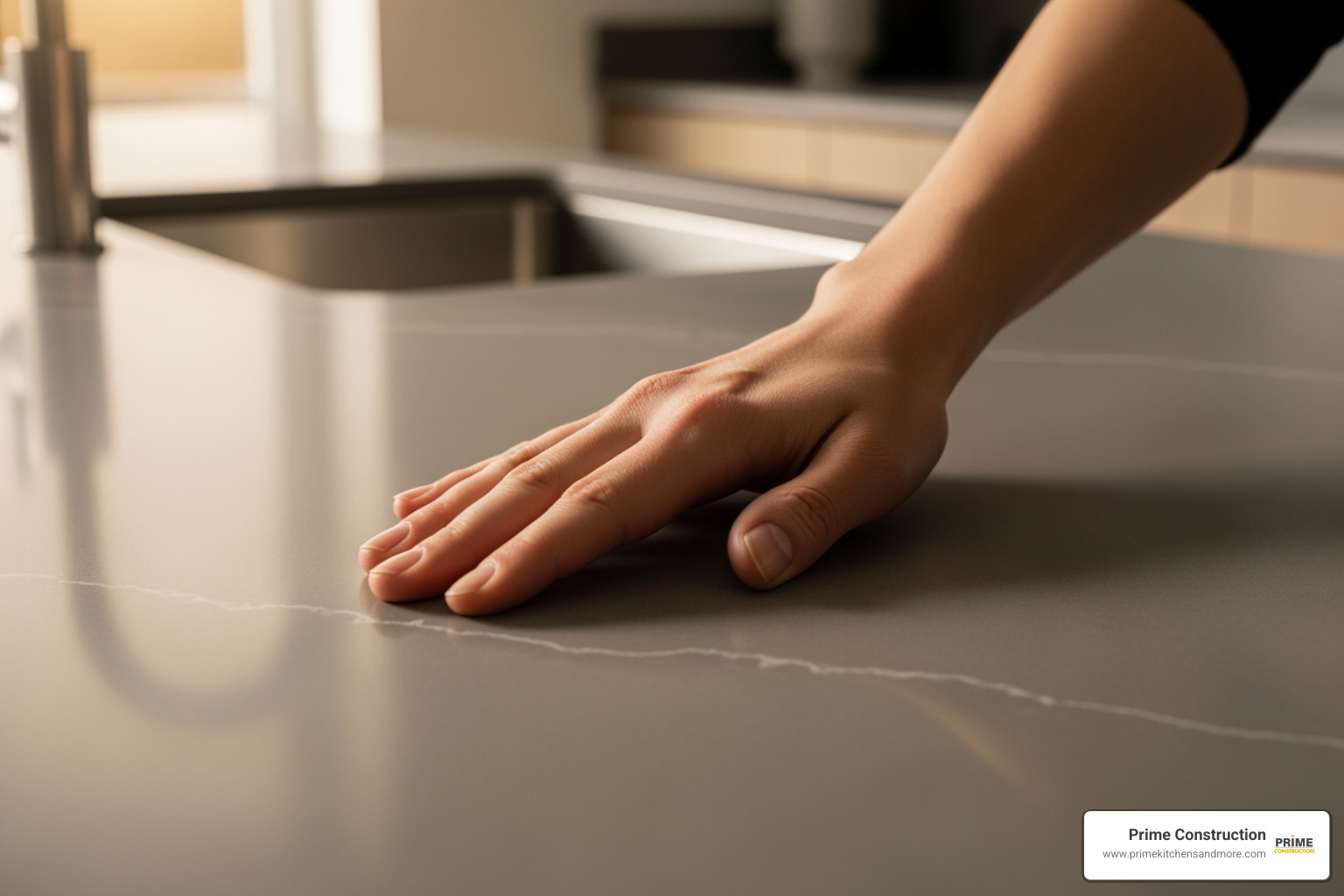
The durability of quartz stone is truly impressive. It stands up to the daily chaos of family life – from dropped dishes to enthusiastic cooking sessions – without showing much wear at all. And here’s the part that makes busy homeowners smile: the maintenance is minimal. No weekend sealing projects, no special cleaners to track down. Just wipe and go.
From a design perspective, engineered quartz gives you incredible flexibility. Want the neat look of marble without the high maintenance? Done. Prefer a bold, contemporary color that natural stone can’t offer? We’ve got you covered. The manufacturing process creates remarkable color consistency across slabs, which means your large island and perimeter counters will match beautifully. While every countertop material will have seams (it’s just physics), the predictable patterns in quartz often make those seams far less noticeable than they’d be with natural stone.
If you’re curious about how we approach the installation process, you’ll find helpful information on our countertop installation page.
Advantages and Disadvantages
Let’s talk honestly about how engineered quartz stone compares to granite and marble. We want you to choose the right material for your lifestyle, not just the trendiest option.
| Feature | Engineered Quartz | Granite | Marble |
|---|---|---|---|
| Durability | Excellent (Mohs 7), highly scratch-resistant | Excellent (Mohs 6-7), very durable | Good (Mohs 3-4), softer, prone to scratches |
| Maintenance | Low, no sealing required | Moderate, requires periodic sealing | High, requires frequent sealing and careful cleaning |
| Stain Resist. | Excellent, non-porous | Good, but porous and can stain if not sealed | Poor, highly porous and easily stained/etched |
| Heat Resist. | Good, but susceptible to thermal shock/damage from extreme heat | Excellent, very heat resistant | Good, but can be susceptible to thermal shock |
| Cost | Moderate to High | Moderate to High (varies by rarity) | High, especially for exotic varieties |
The advantages of engineered quartz are pretty compelling. Because it’s non-porous, liquids simply can’t penetrate the surface – which means that spilled red wine or morning coffee won’t leave a permanent reminder of your mishap. This same quality makes it naturally stain resistant and incredibly hygienic for food preparation areas. At a Mohs hardness of 7, it’s genuinely scratch resistant for everyday use. And perhaps the best part? It’s low maintenance – you’ll never spend a weekend sealing your countertops or worrying about whether you’re using the right cleaner. The consistent appearance across slabs means no surprises when your fabricator pieces together your countertop layout.
Now, let’s be upfront about the limitations. Engineered quartz contains resin binders, which means it’s heat sensitive. Those resins can be damaged by temperatures above 300°F (150°C) or sudden temperature changes, potentially causing discoloration or even cracking. Always use a trivet or hot pad for pots and pans straight from the stove. The same resins also mean quartz isn’t UV stable, so it’s not a good choice for outdoor kitchens or areas that get intense, direct sunlight for hours each day. And while the pattern consistency is usually an advantage, seams may be more visible in certain lighter solid colors or designs with dramatic veining – though our skilled fabricators work hard to minimize their appearance.
Care and Maintenance Tips
Here’s some good news: keeping your quartz stone countertops looking beautiful is remarkably simple. For daily cleaning, just grab a soft cloth, some warm water, and a drop of mild dish soap. That’s honestly all you need most of the time. The non-porous surface means spills sit on top rather than soaking in, so cleanup is quick and easy.
What you want to avoid are harsh chemicals and abrasive cleaners. Skip the oven cleaner, drain opener, or anything with strong acids or alkalis. These can dull the finish or damage the resin binders. Also leave the scouring pads in the drawer – they can scratch even this durable surface.
Even though quartz is scratch-resistant, it’s not scratch-proof. Protect your investment (and keep your knives sharper longer) by always using a cutting board. And remember that heat sensitivity we mentioned? Keep trivets and hot pads handy for anything coming off the stove or out of the oven. This simple habit will prevent potential damage and keep your countertops looking pristine for years.
For more practical advice on maintaining your kitchen surfaces, visit our page with kitchen countertop tips. We’re here to help you get the most out of your investment.
Unique Properties and Safety Considerations
Beyond its beauty, natural quartz stone has fascinating scientific properties. The most remarkable is piezoelectricity, finded by brothers Jacques and Pierre Curie in 1880. They found that applying pressure to a quartz crystal generates an electrical charge, and applying an electric field causes the crystal to deform.
This property allows quartz crystals to vibrate at incredibly precise frequencies. It’s the principle behind the accuracy of quartz watches and clocks. This also makes quartz resonators essential in radios, computers, and sensors. The electronics industry has long depended on quartz, now primarily using synthetic crystals grown in labs for purity and consistency.
Now, while we love talking about the wonderful applications of quartz stone, we also need to address something serious: safety during fabrication. When quartz-containing materials are cut, ground, drilled, or polished, they release crystalline silica dust into the air. These microscopic particles are dangerous when inhaled, potentially causing severe and irreversible lung diseases like silicosis and pulmonary fibrosis. Crystalline silica is also recognized as a human carcinogen by health authorities.
This is exactly why professional fabrication isn’t just about getting clean edges and perfect seams – it’s about protecting people’s health. At Prime Kitchens And More, we take this responsibility seriously. Professional fabricators must use proper dust control measures, including wet cutting methods that suppress dust at the source, local exhaust ventilation systems, and personal protective equipment like respirators. The Hazard Alert – Worker Exposure to Silica document provides detailed information about these risks and proper safety protocols.
When we install your beautiful quartz countertops in Orlando, Winter Park, or anywhere in our service areas, you can rest assured that every cut and polish has been done with both precision and safety in mind. Our 15 years of experience means we understand not just how to create stunning surfaces, but how to do it the right way – protecting our team while delivering the quality you deserve.
Frequently Asked Questions about Quartz Stone
We love talking with our clients throughout Orlando, Seminole County, and Lake Buena Vista about quartz stone countertops. Over our 15 years in business, we’ve noticed the same thoughtful questions coming up time and again. Let’s tackle the most common ones!
What is the difference between quartz and quartzite?
This is hands down the question we hear most often, and for good reason – the names are confusingly similar! Here’s the key difference:
When we talk about quartz for your countertops, we’re referring to an engineered, man-made product. It’s manufactured by combining 90-94% crushed natural quartz crystals with polymer resins and pigments. The result is a non-porous, incredibly consistent surface that performs beautifully in kitchens and bathrooms across Central Florida.
Quartzite, on the other hand, is a completely different animal. It’s a natural metamorphic rock that forms deep in the Earth when sandstone (which contains natural quartz) gets subjected to intense heat and pressure over millions of years. While quartzite is exceptionally hard and often has a stunning marble-like appearance, it’s still a natural stone. That means it’s porous and requires periodic sealing to protect against stains – just like granite does.
So while both materials contain plenty of natural quartz, one is a carefully engineered composite designed for performance, and the other is a beautiful work of geological art. Both have their place, but they’re fundamentally different materials with different care requirements.
Can you put hot pans directly on a quartz countertop?
We wish we could say yes, but we really don’t recommend it. While engineered quartz stone is incredibly durable and can handle a lot, it does have one vulnerability: heat.
The polymer resins that bind all those quartz particles together can be damaged when exposed to sudden temperature changes or sustained heat above 300°F (150°C). We’ve seen what happens when a hot pan gets placed directly on quartz – it can cause discoloration, scorching, or even cracking. Not something anyone wants to see on their beautiful new countertops!
The good news is that protecting your surface is easy. Just keep a few trivets or hot pads handy near your stove. It takes two seconds to grab one before setting down that pot of pasta or your cast iron skillet. Your countertops will thank you, and they’ll stay looking gorgeous for decades.
Does quartz stain or scratch easily?
This is where engineered quartz stone really shines, and it’s one of the main reasons our Orlando clients love it so much!
When it comes to stains, quartz is a superstar. Because the surface is completely non-porous, liquids simply can’t penetrate. That morning coffee spill? The red wine from last night’s dinner party? Just wipe them up with a soft cloth and mild soap, and they’re gone. Unlike porous natural stones, there’s no panicking about permanent staining. This non-porous quality also means bacteria and mold can’t take hold, which makes quartz an exceptionally hygienic choice for food prep areas.
As for scratches, quartz is highly resistant but not completely scratch-proof. Natural quartz ranks 7 on the Mohs hardness scale, and since engineered quartz is 90-94% natural quartz, it inherits that impressive hardness. Your everyday kitchen activities – cutting vegetables, sliding plates around, normal wear and tear – won’t leave a mark. However, we always recommend using a cutting board. It protects your countertops from potential damage and keeps your knives sharper longer. Win-win!
The bottom line? With just a little common sense care, your quartz stone countertops will maintain their beautiful appearance for years to come.
Conclusion
What a journey we’ve taken together through quartz stone! From its humble beginnings as silicon dioxide crystals deep within the Earth to the stunning engineered surfaces gracing modern kitchens and bathrooms, quartz has proven itself to be truly remarkable.
We’ve found that quartz stone encompasses both a ubiquitous natural mineral—ranking 7 on the Mohs hardness scale and making up 12% of Earth’s lithosphere—and a sophisticated engineered material that’s revolutionized home design. The natural varieties, from purple amethyst to banded agate, showcase the incredible diversity of this mineral. Meanwhile, engineered quartz represents human ingenuity at its finest, combining 90-94% crushed natural quartz with resins and pigments to create surfaces that are both beautiful and exceptionally practical.
The appeal of engineered quartz stone for your Orlando home renovation is clear. Its non-porous surface means you’ll never need to seal it. Its stain resistance and scratch resistance mean less worry and more enjoyment of your beautiful new space. The durability stands up to everything your busy household can throw at it, while the aesthetic versatility allows you to achieve any look you’re dreaming of—whether that’s classic marble elegance or bold contemporary design.
At Prime Kitchens And More, we’ve spent 15 years perfecting the art of home remodeling right here in Orlando and throughout Orange County, Seminole County, and surrounding areas. We specialize in full house remodels, with a particular passion for kitchen and bathroom changes. Working with premium materials like quartz isn’t just what we do—it’s what we love. We take pride in helping homeowners like you create spaces that are both stunning and supremely functional, spaces that truly lift your daily life.
When you choose to work with us, you’re choosing a team that understands both the science and the art of beautiful surfaces. We know how to properly fabricate and install quartz stone countertops to ensure they’ll serve you beautifully for decades to come. Our commitment to high-quality results and complete customer satisfaction means we’re with you every step of the way, from initial design consultation to the final reveal.
Ready to experience the perfect marriage of natural beauty and modern engineering in your own home? Whether you’re planning a complete kitchen overhaul or updating your bathroom vanities, we’re here to help you explore all the possibilities that quartz offers. Explore our ultimate guide to quartz bathroom countertops for more inspiration, or reach out to us today for a personalized consultation. Let’s create something beautiful together!