

What Is a Commercial Rebuild — and Do You Need One?
Acommercial rebuildis the process of demolishing and reconstructing a commercial property from the ground up — either after serious damage or when a building has simply outlived its usefulness in its current form.
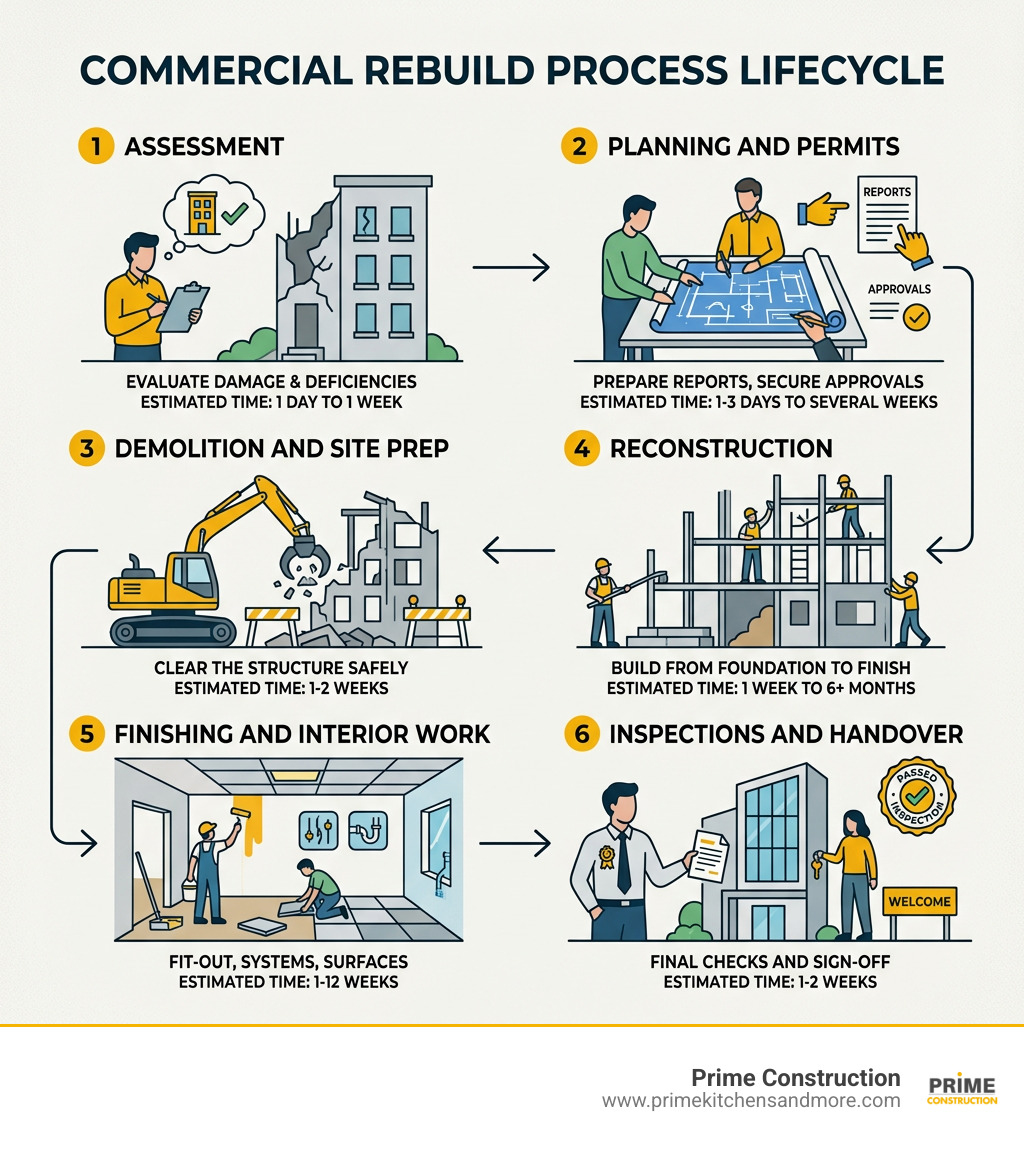
Here’s a quick overview of what the process typically involves:
- Assessment— Evaluate damage or deficiencies (1 day to 1 week)
- Planning and permits— Prepare reports, secure approvals (1–3 days to several weeks)
- Demolition and site prep— Clear the structure safely (1–2 weeks)
- Reconstruction— Rebuild from foundation to finish (1 week to 6+ months)
- Finishing and interior work— Fit-out, systems, surfaces (1–12 weeks)
- Inspections and handover— Final checks and sign-off (1–2 weeks)
Simple projects can wrap up in a matter of weeks. Complex ones can take six months or more.
Whether you’re dealing with fire damage, flooding, aging infrastructure, or a building that no longer fits your business — rebuilding is a major decision. And it’s not always obvious when it’s the right call versus a renovation or remodel.
The stakes are high. Research shows that79% of commercial properties are underinsured, with an average coverage shortfall of 63%. That means most businesses facing a rebuild are starting from a weaker financial position than they realize.
This guide breaks down everything you need to know — from understanding when a full rebuild makes sense, to navigating timelines, budgets, insurance, and regulations — so you can make a confident, informed decision.
Relevant articles related tocommercial rebuild:
Understanding the Scope: Renovation vs. Remodeling vs. Commercial Rebuild
When we talk about updating a business space in Central Florida, we often hear the terms renovation, remodeling, and rebuilding used interchangeably. However, in the construction world, they represent very different levels of commitment, cost, and structural impact.
| Feature | Renovation | Remodeling | Commercial Rebuild |
|---|---|---|---|
| Definition | Restoring to “like-new” condition | Changing the layout or function | Tearing down and starting over |
| Structural Changes | Minimal to none | Moderate (moving walls) | Total (new foundation/framing) |
| Aesthetic Updates | High (paint, flooring, fixtures) | High (new configuration) | Complete blank canvas |
| Property Value | Steady increase | Significant boost | Maximum potential ROI |
| Best For | Cosmetic refreshes | Changing business use | Severe damage or total obsolescence |
Renovationis essentially a “face-lift.” We might update the flooring in your Winter Park office or swap out the lighting in a Maitland retail shop. It restores the building to its original glory without changing how the space is used.
Remodelinggoes a step deeper. This involves changing the DNA of the room. If you’re turning an old warehouse in Ocoee into a trendy restaurant, you’re remodeling. You might move walls, add plumbing for a commercial kitchen, or reconfigure the entrance to improve customer flow.
Acommercial rebuild, on the other hand, is the nuclear option. It involves dismantling the existing structure—often down to the slab or even removing the foundation—and building a brand-new facility. While it sounds daunting, it is often the most logical path when the existing “bones” of the building can no longer support your business goals.
When a Full Commercial Rebuild is Necessary
We often consult with business owners in Orlando and Orange County who are torn between a massive renovation and a total rebuild. While we love a good transformation, there are specific scenarios where acommercial rebuildis the only responsible choice:
- Severe Structural Damage:If a fire, major flood, or sinkhole has compromised the integrity of the steel or concrete, patching it up is often more expensive (and less safe) than starting over.
- Outdated Infrastructure:Many older buildings in areas like Apopka or Eatonville have electrical and HVAC systems that simply cannot handle modern technology. If the cost of retrofitting these systems exceeds 50% of the building’s value, a rebuild is usually more cost-effective.
- Zoning and Compliance:Sometimes, local zoning laws change. To bring an old building up to currentADA (Americans with Disabilities Act)standards or modern Florida building codes, you might have to alter so much of the structure that it’s easier to design a compliant building from scratch.
- Maximum ROI:If the land value has skyrocketed but the building is a “Class C” property, rebuilding into a “Class A” space can drastically increase your rental income or resale value.
For a deeper dive into these options, check out ourreconstruction services guide.
Pros and Cons of Rebuilding vs. Renovating
Choosing between these two paths is a balancing act of time, money, and sustainability.
Pros of Rebuilding:
- Customization:You get a blank canvas. We can design the layout specifically for your current workflow.
- Efficiency:Modern builds allow for the latest insulation, high-efficiency HVAC, and smart-glass windows, leading to massive long-term energy savings.
- Longevity:A new building has a longer lifespan and lower maintenance costs over the first 10–15 years.
Cons of Rebuilding:
- Upfront Cost:It requires a larger initial capital investment.
- Time:You’ll need to factor in demolition and longer permitting phases.
- Environmental Impact:Demolition creates more waste than afull gut renovation.
Interestingly, the “green” argument is a 50/50 split. While renovations produce fewer carbon emissions during construction, acommercial rebuildallows you to meet the strictest modern energy standards, which can make the new building more sustainable over its entire lifecycle.
The Commercial Reconstruction Process: From Assessment to Handover

At Prime Kitchens And More, we believe transparency is the key to a stress-free project. Whether we are working in Windermere or Baldwin Park, we follow a rigorous 8-step process to ensure yourcommercial rebuildstays on track.
- Damage & Needs Assessment:We spend 1 day to 1 week evaluating the site. If it’s an insurance claim, we use advanced tools like Matterport to document every square inch.
- The Assessment Report:Within 1–3 days, we provide a detailed report that serves as the blueprint for your budget and insurance claim.
- Site Preparation:This takes about a week. We secure the site, set up temporary utilities, and ensure safety barriers are in place.
- Demolition & Debris Removal:This is the “messy” phase, usually lasting 1–2 weeks. We don’t just knock things down; we sort materials for recycling and ensure hazardous waste is handled properly.
- Reconstruction Phase:This is the meat of the project. For a small retail unit, it might take a week; for a complex office building, it could be 6 months or more.
- Finishing & Interior Work:This is where our expertise inreconstruction servicesshines. We handle the drywall, flooring, and specialized cabinetry that makes your business look professional.
- Testing & Final Inspections:We spend 1–2 weeks ensuring every pipe, wire, and fire alarm meets Florida’s strict commercial codes.
- Cleanup & Handover:We perform a post-construction deep clean and a final walkthrough with you to ensure every detail is perfect.
Navigating Timelines and Potential Delays
In Central Florida, we have a few unique “timeline hijackers” that every business owner should be aware of:
- The Weather:Hurricane season (June through November) can cause significant delays in exterior work. We always build a “weather buffer” into our schedules for projects in Kissimmee and Lake Buena Vista.
- Material Shortages:While the supply chain has stabilized, specialized items like commercial-grade electrical panels or custom HVAC units can still have long lead times.
- Labor Availability:Skilled trades are in high demand. Working with an establishedrestoration contractorlike us ensures you have a dedicated team that won’t disappear halfway through the job.
Minimizing Disruptions and Business Downtime
We know that every day your doors are closed is a day of lost revenue. To minimize the “ouch” factor, we employ several strategies:
- Phased Construction:If your property allows, we can rebuild in sections, allowing you to keep part of your operation running.
- Off-Peak Scheduling:We can coordinate noisy demolition or heavy deliveries during hours that don’t disturb your neighbors or remaining staff.
- Turnkey Management:By serving as your single point of contact, we eliminate the “he-said, she-said” delays that happen when you try to manage five different subcontractors yourself.
Budgeting for Your Commercial Rebuild: Hidden Costs and Financial Planning
Budgeting for acommercial rebuildis not just about the cost of bricks and mortar. In our 15 years of experience in the Orlando area, we’ve seen that it’s the “hidden” costs that usually catch people off guard.
When you’re looking at yourhome gut renovation costas a baseline, commercial projects involve much higher stakes and stricter regulations.
Common Budget Factors:
- Demolition & Site Clearance:Safely dismantling a building and hauling away tons of debris is a significant expense.
- Professional Fees:You’ll need a team of architects, structural engineers, and project managers. These fees typically range from 10% to 15% of the total project cost.
- Permit Costs:Depending on whether you’re in Winter Garden or Edgewood, permit fees can vary significantly and often include impact fees for the local infrastructure.
- Temporary Utilities:Keeping the lights on and the site safe during construction adds up over several months.
The Critical Role of Insurance in a Commercial Rebuild
This is where things get serious. As we mentioned,79% of commercial properties are underinsured. This usually happens because owners base their coverage on “market value” rather than “rebuild cost.”
If your building in Pine Hills is worth $1 million on the market, but it would cost $1.8 million to rebuild it to modern codes after a fire, you have a massive shortfall. We work closely with insurance carriers to provide “insurer-ready” reports that help bridge this gap. We advocate for the insured, ensuring that the claim covers the actual cost of high-quality materials and professional labor.
Material Costs and Modern Green Building Standards
Modern materials are smarter, but they can be more expensive upfront. However, as a specializedrehab contractor, we emphasize the long-term savings of “Green Building.”
- Sustainable Materials:Using recycled steel or sustainable wood isn’t just good for the planet; it often comes with tax incentives.
- Energy Efficiency:Investing in high-performance insulation and LED systems can reduce your monthly utility bills by 30% or more.
- Smart Technology:Integrating smart HVAC and lighting controls during the rebuild phase is much cheaper than retrofitting them later.
Regulatory Compliance and Modern Building Standards
Navigating the legal landscape in Orange and Seminole Counties is a full-time job. Acommercial rebuildmust comply with a mountain of regulations that simply didn’t exist 20 years ago.
- Zoning Laws:You must ensure your new building’s footprint, height, and usage align with current local ordinances.
- ADA Compliance:This is non-negotiable. From door widths to ramp slopes and restroom layouts, your rebuild must be accessible to everyone.
- Historical Protections:If you’re rebuilding in a historic district like Winter Park or parts of Maitland, you may face strict limitations on the exterior materials and colors you can use.
- Florida Building Codes:Our state has some of the toughest wind-load and flood-zone requirements in the country. Your rebuild must be designed to withstand the next big storm.
For a complete breakdown of these requirements, see ourrestoration general contractor complete guide.
Trends Shaping Modern Commercial Reconstruction
We aren’t just building boxes anymore; we’re building experiences. Here are the trends we’re seeing in our recent projects:
- Flexible Office Design:Instead of cubicles, businesses are asking for modular layouts that can be reconfigured as the team grows or shifts to hybrid work.
- Employee Well-being:We’re seeing a huge demand for “biophilic” design—incorporating natural light, indoor plants, and better air filtration systems.
- Smart Technology:Buildings are becoming “living” entities with sensors that adjust temperature and lighting based on occupancy.
Choosing the Right Partner for Your Project
Acommercial rebuildis a marathon, not a sprint. You need a partner who understands the local landscape of Central Florida and has the craftsmanship to back up their promises.
At Prime Kitchens And More LLC, we bring 15 years of experience to every project. While we are known for our premium kitchen and bathroom designs, that same attention to detail translates perfectly to commercial spaces. Whether it’s a high-end restaurant kitchen or a sleek corporate restroom, we use only premium materials to ensure your business makes the right impression.
Selecting a Specialized Commercial Reconstruction Team
When vetting contractors for your project in Alafaya, Bay Hill, or Belle Isle, look for these three things:
- Local Expertise:Do they know the specific permitting quirks of Orange County?
- Insurance Handling:Can they speak the “language” of insurance adjusters to ensure your claim is handled fairly?
- Portfolio Review:Don’t just take their word for it. Look at their finished work in the local area.
Frequently Asked Questions about Commercial Rebuilds
How long does a typical commercial rebuild project take?
While small projects can wrap up in a few weeks, a standardcommercial rebuildusually takes between4 to 8 months. This includes about 1–2 months for planning and permitting, 1 month for demolition, and 3–5 months for actual construction and finishing.
Is rebuilding greener than renovating an existing structure?
It’s a toss-up. Renovation has a lower “embodied carbon” footprint because you aren’t throwing away an entire building. However, a rebuild allows for much higher energy efficiencystandards, which can result in a smaller carbon footprint over the next 50 years.
What are the most common hidden costs in reconstruction?
The “big three” are:
- Hazardous Materials:Finding asbestos or lead paint during demolition.
- Subsurface Issues:Discovering poor soil quality or old, leaking pipes under the foundation.
- Code Upgrades:Being forced by the city to upgrade theentireproperty’s landscaping or parking lot just because you rebuilt the main structure.
Conclusion
Acommercial rebuildis more than just a construction project; it’s a bold investment in the future of your business. Whether you are recovering from a disaster or modernizing an outdated space in Gotha, Holden Heights, or Hunters Creek, the goal is the same: a safe, efficient, and beautiful environment that helps your business thrive.
From the first damage assessment to the final walkthrough, our team at Prime Kitchens And More is here to guide you through every step. We handle the complexities of insurance, permits, and project management so you can focus on what you do best—running your business.
Ready to transform your property?Start your project with our professional reconstruction servicestoday.